In this article
- The short answer
- How do you choose a good safeword?
- What do red, yellow, and green mean?
- How should you practice the signal before a scene?
- How do you talk about safewords with a partner?
- What should happen when someone uses a safeword?
- What if someone does not use the safeword?
- What are the common misconceptions about safewords?
- Frequently asked questions
- Key takeaways
The short answer
Safewords are pre-agreed words, phrases, gestures, or other signals that tell everyone in a BDSM scene to pause, change course, or stop. They give you a clear way to communicate when ordinary conversation is difficult, especially during intense role-play or restraint. A safeword supports consent, but it does not replace negotiation, observation, practical skill, or the right to stop without using one.
The meaning belongs to the people using it. “Red” may mean stop immediately and “yellow” may mean pause or check in, but those meanings must be agreed before the scene starts. No color system is universal, and no signal makes a high-risk activity safe by itself.
Think of a safeword as an emergency communication tool, not a permission slip. The goal is to make stopping easy, respected, and pleasantly unremarkable.
How do you choose a good safeword?
Choose a word that is easy to remember, easy to pronounce under stress, and unlikely to appear in ordinary scene language. “Red” is familiar and quick, which is useful. A less expected word can work better if “no” and “stop” have been deliberately included in the role-play. The cleverness of the word matters far less than everyone’s response to it.
Say the word aloud together. Notice if either of you stumbles over it, mishears it, or feels awkward saying it firmly. A short phrase can be useful if a single syllable might get lost, but it still needs to be clear. A word such as “pineapple” is not a standard requirement or a magic community password. Use it only if it works for you.
Decide how many signals you need. Some partners use one hard-stop word. Others use a two-level system, with one signal for “stop now” and another for “pause and adjust.” A traffic-light system adds a third signal for “this is working,” but you can also use ordinary check-ins for that purpose.
Everyone in the scene needs access to a stop signal. That includes a dominant, top, submissive, bottom, or switch. The person directing the activity may notice a problem first, and they should be able to stop without having to wait for someone else to speak.

What do red, yellow, and green mean?
Red, yellow, and green are common shorthand, not a universal rulebook. A widely used version is simple: red means stop immediately, yellow means pause or slow down and check in, and green means the current activity is welcome. Before play, define the exact meaning of each word in your scene.
“Yellow” needs particular care. One person may mean “reduce the intensity,” while another means “stop completely and talk.” Neither interpretation is wrong, but guessing is a poor substitute for agreement. You might define yellow as “pause, keep the equipment in place, and ask me one question,” or as “stop this activity and move to something else.” Be specific.
Green is often treated as reassurance, but it is not a running permission slip. A green response about one activity does not automatically cover another. Consent can change during the scene, and a person can withdraw it at any point.
A single stop word can be just as effective. So can several signals for different needs. The useful system is the one both people understand when the room is quiet, the lights are low, and nobody is trying to remember a complicated chart.
How should you practice the signal before a scene?
Practice once before introducing restraints, blindfolds, gags, intense role-play, or complicated equipment. Say the stop word aloud. If you have a nonverbal signal, make it deliberately and confirm that your partner saw or heard it. This small rehearsal removes the theater from the moment when clarity matters most.
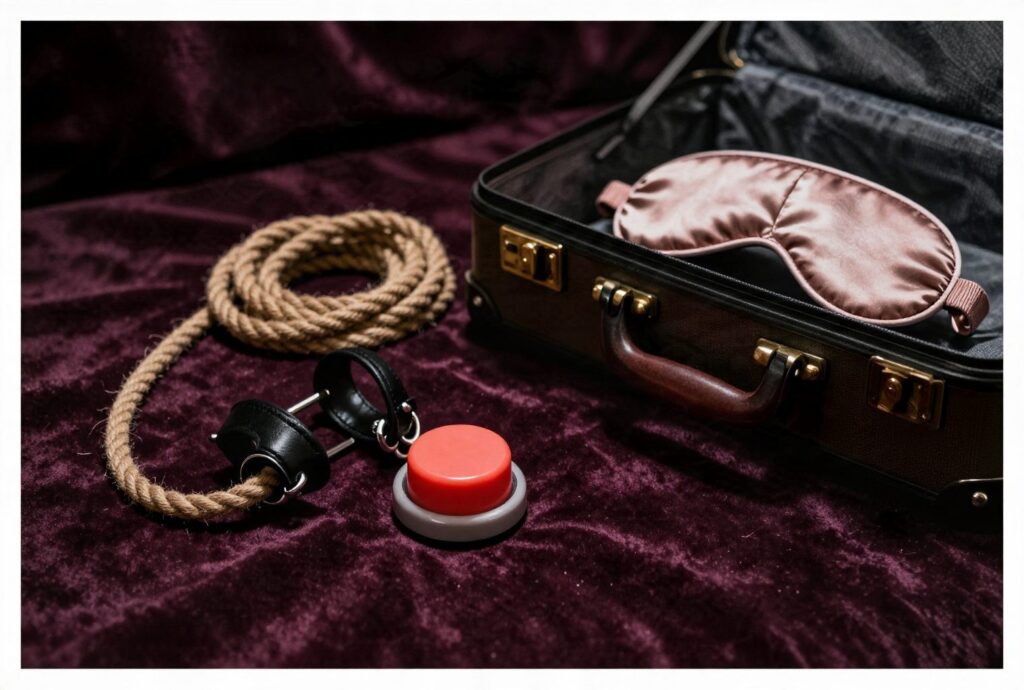
A person who may not be able to speak needs an alternative signal. It might be a visible hand movement, a dropped object, a repeated sound, or another deliberate action. It should be physically possible, visible or audible, and understood by everyone. Test it from the position and distance you expect to use. A signal that works across the room may not work with a blindfold on.
Do not rely on a hand gesture that could happen by accident. Do not choose a signal that requires fine movement if someone may be restrained. If a gag is involved, the alternative must be agreed and tested before it is used. If the signal is missed, the activity cannot be called safe simply because the person had technically been given one.
It also helps to rehearse the response. One person says or gives the signal, and the other practices stopping, releasing equipment as needed, and asking what comes next. This is not a performance test. It is a way to make the correct response automatic.
How do you talk about safewords with a partner?
Have the conversation before the scene, when everyone is sober, awake, and able to think clearly. Start with what you want to try, then discuss hard limits, softer limits, equipment, safer-sex plans, and anything that might affect communication. Agree on the safeword and the signal, but also agree on what you will do if someone becomes quiet, confused, frightened, or physically uncomfortable.
A useful question is, “What should I do when you say yellow?” The answer should describe an action, not a mood. “Stop and ask me what needs to change” is clearer than “be careful.” Ask the same question in reverse. A top is not the only person allowed to pause a scene, and a bottom is not the only person expected to monitor it.
If “no” or “stop” will be part of the role-play, say that plainly and choose a separate safeword that always overrides the scene. If those ordinary words are not part of the role-play, treat them as stop signals. There is no prize for making the system harder to interpret.
Consent can be withdrawn after an earlier yes, during an ongoing activity, or after a written agreement. A relationship, previous experience, arousal, or a submissive role does not change that. If someone uses a safeword, do not shame, punish, bargain with, or interrogate them for doing exactly what the system was designed to allow.
If you want more help starting this conversation, our guide on talking about kink with a partner covers the first approach in plain language. The same principles apply here: be direct, leave room for a real answer, and treat hesitation as information.
Our advice: rehearse the stop signal before the scene, then make stopping boringly easy. A good safeword should never require courage to use.

What should happen when someone uses a safeword?
The safest default is immediate action. Stop the activity, release restraints or equipment as needed, and check the person’s condition. Do not finish one last motion, ask them to explain first, or negotiate while the activity continues. The word has already done its job.
- Stop the current activity immediately.
- Make the person physically comfortable and release equipment as needed.
- Ask what they want next, without pressure.
- Offer practical care, privacy, water if wanted, and calm reassurance.
- Debrief later, when everyone has settled and can speak clearly.
A yellow signal may lead to a pause and adjustment if that is what you agreed. A red signal should be treated as a full stop. If the meaning is unclear in the moment, stop first. Sorting out the wording can wait until nobody is at risk.
Stopping does not require a dramatic explanation. Someone may be tired, overwhelmed, uncomfortable, distracted, or simply finished. “I’m done” is enough. Aftercare can be quiet: a blanket, a glass of water, a shower, space, conversation, or practical help. It is support, not a guarantee against medical or emotional problems.
What if someone does not use the safeword?
Do not make the person responsible for identifying every unsafe moment. A safeword is not a substitute for active observation. Freezing, pulling away, going silent, looking confused, or appearing distressed are reasons to stop and check in, even if no formal word has been spoken.
Silence is not automatic consent. Neither is submission, sleep, unconsciousness, intoxication, or impairment from alcohol or drugs. Everyone must be able to make an informed decision at the time. Someone can say yes to one activity and no to another, and can change their mind without presenting a legal brief.
For activities involving breathing restriction, neck pressure, suspension, severe impact, needles, electricity, fire, or complex restraints, a safeword is nowhere near enough preparation. Those activities require specific education, suitable equipment, emergency planning, and ideally supervised instruction from an experienced practitioner or a relevant class. If there is injury, loss of consciousness, breathing difficulty, confusion, severe pain, or another emergency, stop and seek emergency medical help.
Consent and risk laws vary by U.S. state and country; check current official law for the jurisdiction involved, because a safeword is not a universal legal defense or medical protection.
What are the common misconceptions about safewords?
The first misconception is that every BDSM scene requires a safeword. Many people use one, and it is especially useful when ordinary language may be ambiguous. But consent can also be communicated through straightforward speech and frequent check-ins. The important part is a clear, respected way to pause or stop.
The second is that using a safeword means someone failed. It means the communication system worked. Bodies and feelings change. A sensation that seemed manageable during negotiation may not feel right ten minutes later. A respectful partner responds to the signal, not to their disappointment about it.
The third is that the word protects you automatically. It cannot help if a partner ignores it, misses a nonverbal signal, or lacks the skill for the activity. It cannot replace boundaries, sober decision-making, equipment knowledge, or attention to the person in front of you.
The fourth is that “red” and “yellow” mean exactly the same thing everywhere. They do not. Communities and relationships vary, and research on safeword use remains limited. Treat familiar customs as a starting point, then write your own plain-language agreement.
Finally, a safeword does not excuse retaliation. If a partner mocks you, punishes you, pressures you to continue, or ignores a clear stop signal, prioritize leaving the situation and contacting a trusted person or appropriate support service. That is not a communication glitch. It is a serious breach of consent.
When you are choosing a private room for a scene, the Kinkstay atlas of kink-friendly stays can help you compare spaces by the equipment hosts declare. Remember that Kinkstay reads host-submitted listings but does not visit the rooms, so discuss access, setup, and safety arrangements directly with the host before booking.
Frequently asked questions
What is a safeword, and why do people use one?
A safeword is a pre-agreed word, phrase, gesture, or signal used to pause, change, or stop BDSM activity. People use one because ordinary words may be unclear during role-play, intense emotion, distance, or restraint. It supports consent but does not replace negotiation or observation.
How do I choose a good safeword?
Choose something easy to remember and pronounce, and unlikely to be confused with ordinary scene language. Agree on its exact meaning before starting, then say it aloud and rehearse the response. A familiar word, an unusual word, or a single stop signal can all work.
What do red, yellow, and green mean in BDSM?
They are commonly used as a traffic-light system: red means stop, yellow means pause or adjust, and green means the current activity is welcome. These meanings are not universal. Define each one clearly for your own scene, especially yellow.
Is “no” or “stop” enough, or should I choose a different word?
It depends on the scene. If “no” and “stop” are part of role-play, choose a separate word that always overrides it; otherwise, treat them as immediate stop signals. Never use a special word as a reason to disregard ordinary signs of distress.
What can I use if I cannot speak?
Use a deliberate, visible or audible signal that everyone understands and that the person can physically make. Test it before restraints, blindfolds, or gags are introduced, and test it from the distance and position of the planned activity. If it is missed or uncertain, stop and assess.
Key takeaways
- Choose the signal and define its meaning before the scene begins.
- Use a tested nonverbal signal whenever speech may be difficult.
- Stop immediately, release equipment as needed, and check in when a signal is used.
- A safeword supports consent; it never replaces boundaries, training, observation, or the right to stop without one.